
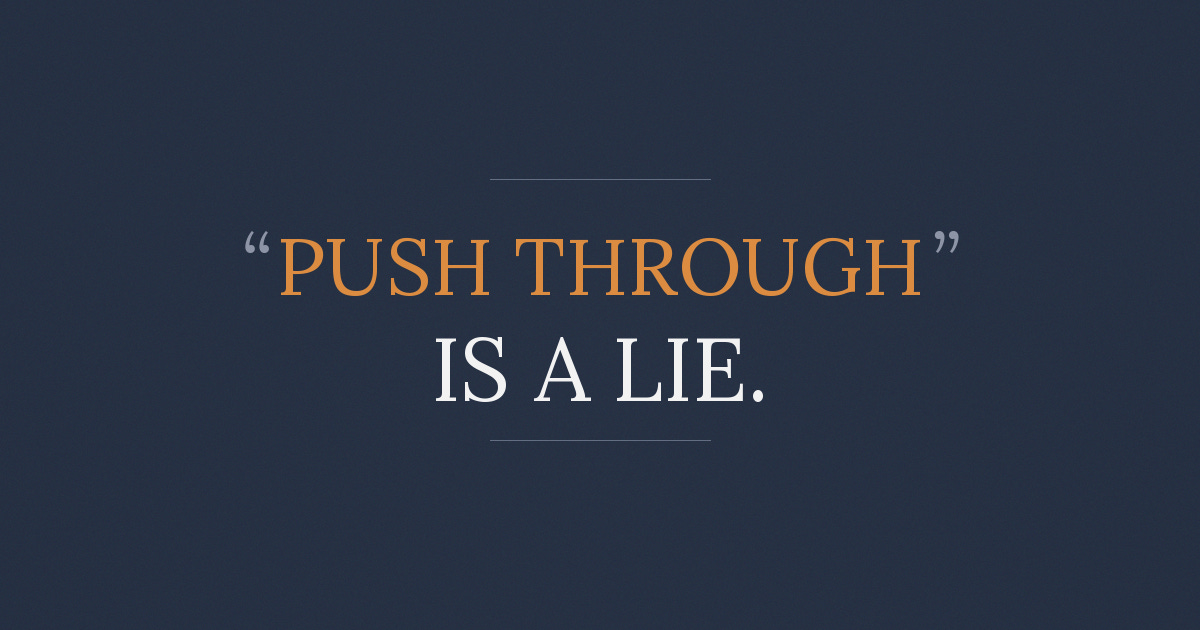
Somewhere along the way, we decided that the answer to human suffering was to ignore it harder.
Tired? Push through. Anxious? Push through. Burned out? Push through. Body screaming at you to stop? Push. Through.
It’s the most celebrated piece of bad advice in modern culture. And it’s killing people. Slowly. Quietly. In ways that don’t show up on a performance review.
I should know. I pushed through for decades.
I pushed through headaches that turned out to be warning signs. I pushed through anxiety that was actually my nervous system begging for rest. I pushed through exhaustion that my body was using as a last-ditch effort to get my attention.
Then I couldn’t push anymore. Because my body stopped asking and started demanding. A brain aneurysm discovery has a way of ending the conversation about whether you can afford to slow down.
But here’s what I want you to hear—not my story. The lie underneath the advice.
“Just push through” is built on a specific belief: that your body is an obstacle to your goals. That physical discomfort is weakness. That the signals your nervous system sends—fatigue, pain, anxiety, brain fog—are inconveniences to be overridden, not information to be heeded.
This belief has a name in neuroscience. It’s called top-down override—using your conscious mind to suppress your body’s signals. And it works. For a while. The same way running a car engine without oil works. For a while.
Your body keeps score. Dr. Bessel van der Kolk wrote the definitive book on this. Every moment of overwhelm, every overridden signal, every suppressed need—your nervous system catalogs it. Files it away. Runs defensive programs based on the accumulated data.
You don’t get to push through without consequence. The bill always comes.
It comes as the autoimmune disorder that baffles your doctor. The insomnia that no supplement fixes. The digestive issues that appeared out of nowhere. The anxiety that settled in like a permanent roommate. The depression that looks nothing like sadness—more like numbness, flatness, the inability to feel anything at all.
These aren’t random. They’re the receipt.
The culture that celebrates pushing through is the same culture that profits from your burnout. Your exhaustion is someone else’s revenue stream. Your chronic stress keeps you consuming—caffeine to start, alcohol to stop, content to numb, products to fix what isn’t broken.
I’m not saying you should never do hard things. I’m saying there’s a difference between choosing difficulty and ignoring damage. Between pushing toward something meaningful and pushing through your body’s desperate attempt to save your life.
The people who built the “push through” culture aren’t the ones who pay the price. They’re the ones selling you solutions after you collapse.
Here’s what I’ve learned—in my body, not just my mind:
The opposite of pushing through isn’t giving up. It’s listening. It’s treating your body as a partner instead of an obstacle. It’s understanding that the signals it sends are data, not weakness.
When your body says slow down, it’s not because you’re lazy. It’s because something needs attention. And the longer you ignore it, the louder it gets—until it doesn’t ask anymore. Until it takes.
The framework I built—the one in the book coming out March 15—starts here. With Safety. With giving your nervous system the one thing it’s been begging for: the message that the emergency is over. That you can stand down. That it’s safe to heal.
Everything else builds from there. But nothing works until your body believes the war is over.
Stop pushing through.
Start listening.
GET ON THE LAUNCH TEAM — LIMITED TO 100 PEOPLE

