
Two Tim Eldreds Walk Into the Internet
What a Stranger with My Name Never Meant to Teach Me
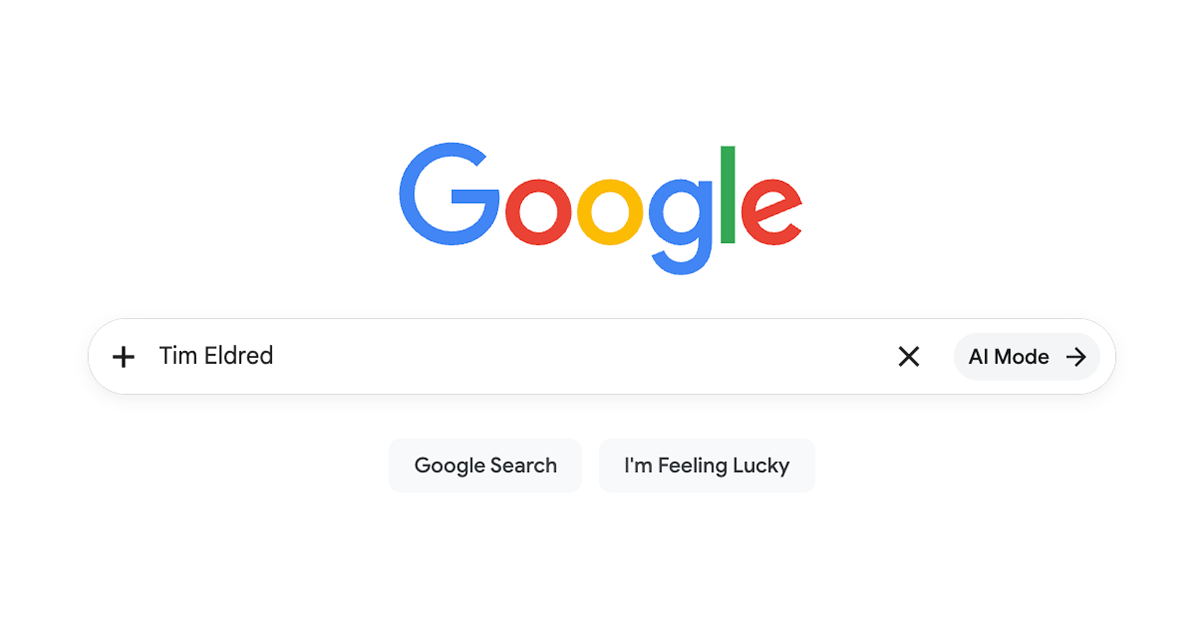
I’ve been cursing a man for years.
Not out loud. Not with malice. Just low-grade irritation. But every time I tried to stake my claim online—every time I tried to own the URL that should’ve been mine—it was already taken. Occupied. Home to someone else living a different life under my name.
Tim Eldred. Los Angeles. Writer. Artist.
He got there first. Beat me to it. And because he did, I had to go somewhere else.
So I became Timothy Eldred.
Not Tim. Not T. Eldred. Not some workaround that felt like a consolation prize. I went the other direction entirely—I took the longer version. The formal version. The name on my birth certificate nobody called me (unless I was in trouble).
Timothy Eldred became my author name. My URL. My brand. My byline. Every platform, every bio, every speaking introduction. Because Tim Eldred was already taken by a man in California I’d never spoken with or expected to.
I didn’t think much about it after the decision was made. You adapt. You move on. You build what you can build with what you have.
Until last week, when he messaged me.
He introduced himself as “other me.”
He said he’d been seeing my name online for years—which I already knew because I’d been seeing his—but that he’d never looked closer because we clearly traveled different paths. But last week, he got curious. Searched his own name (the way all of us do) and found me again. He looked at my podcast. Read my blog. And saw this line:
“The life you’re performing and the life you’re meant to live are not the same. That gap is what I work in.”
He wrote to tell me that for years—long before he knew I existed—he’d been living by his own version of the same idea. Here’s exactly how he said it:
“The space between what you have and what you wish for is where your character comes from.”
I read that twice. Then a third time. Then I sat with it for a moment to let it sink in. Because I realized something I don’t think either of us had fully understood yet.
He creates characters for a living.
I help people escape the caricature masking their character.
Same mission. Opposite methods. And neither of us knew the other’s philosophy.
Let me say that again more slowly. Because I think it matters. I help people escape the caricature. The one masking their character. The one they didn't know was there.
A caricature isn’t a lie. That’s what makes it so insidious. It doesn’t invent something that was never there—it takes something real and exaggerates it until the original disappears behind the distortion. It warps actual features until the person underneath becomes unrecognizable. Even to themselves.
That’s exactly what performance does to people.
You don’t start performing from nothing. You start with something real—a real person, real instincts, real identity—and then life starts applying pressure. Family pressure. Cultural pressure. Religious pressure. Professional pressure. The pressure of wanting to belong, wanting to be enough, wanting to survive in rooms that required a version of you that was easier to accept than the actual one.
And over time, that pressure distorts. Exaggerates. Hardens certain features and erases others until what’s left is a caricature—recognizable enough that nobody calls it out. Distorted enough that the person living inside it has long since forgotten what the original looked like.
That’s what I’ve spent 35 years working on. Not building people up from scratch. Excavating them. Stripping away the distortion until the actual person—the one who was always underneath—can finally surface.
And Tim—the other Tim—has spent his career doing the opposite. Starting with nothing. Building character up from a blank canvas. Giving dimension to people who didn’t exist before he put pen to paper.
He creates character. I excavate it.
He builds from a blank canvas. I clear the debris.
Opposite directions. Same destination.
He’s a character architect.
I’m a transformation architect.
We just didn’t know we were building in the same neighborhood.
But here’s the part that should bother you.
His philosophy—the one he’d been carrying for years—described exactly what he had done to me without knowing it.
“The space between what you have and what you wish for is where your character comes from.”
I wanted timeldred.com. He had it. That gap—that distance between what I reached for and what I got—is where timothyeldred.com came from.
He built my character without knowing I existed.
Sit with that. Because this is where it stops being a good story and starts being something that should genuinely unsettle you.
We tell ourselves a very clean narrative about identity. We chose it. We built it. We decided who we were going to be and then became that. We own it because we authored it. But that’s not how it works. That’s never how it works.
Identity forms in resistance. In limitation. In the moments when the path you planned hits something immovable and you have to decide. Do I stop here? Or do I find another way through?
I found another way through. I took the longer name. And in doing so, I became something more specific, more serious, more ownable than I might have been if the shorter path had been open. Timothy isn’t a nickname. It doesn’t do casual well. It doesn’t do small well. It carries a weight that Tim doesn’t. And whether I earned that weight or inherited it by necessity, it became mine.
The man who blocked my path built the path I actually needed to walk.
He did it without knowing my name. I cursed him without knowing his. And somewhere in that gap, I became more fully myself than I might have otherwise.
I don’t know what to do with that except tell you that this is how it always works.
The things that form us most profoundly are almost never the things we chose. They're the closed doors. The occupied URLs. The detours we didn't ask for that turned out to be the actual road. The pressure that distorted us ultimately revealed that the distortion was never the truth of us. Just the debris.
Most people spend enormous energy resenting that. Fighting it. Building a story about what their life would have looked like if the path had been clear. If the thing they reached for hadn’t already been taken.
But the resistance is the mechanism. Not the obstacle to it.
You are not entirely self-authored. None of us are.
The version of you that exists right now was shaped in large part by things that happened to you, not things you chose. By doors that closed. By people who got there first. By losses that forced you left when you were planning to go right. By pressure that exaggerated certain features until you forgot what you looked like.
And somewhere underneath all of that—underneath the caricature, underneath the performance, underneath the distortion—there is a person.
Not a performed person. Not a distorted person. Not the person you’ve been presenting so long you’ve started to believe it yourself. The actual one. The one that was always there. The one that forms—not in the absence of the gap, but inside it.
I wrote Tim back and told him he’d beaten me to it. That I’d been cursing him for owning the URL I wanted. That this conversation would become a blog and a podcast. And that if I ever made it to LA, I’d reach out about a drink.
We grew up forty minutes apart. Built entirely different lives. And independently arrived at the same address without knowing the other existed.
Two Tim Eldreds. One creates character from nothing. One helps people find their way back to the character they buried under everything they were pretending to be.
Same mission. Mirror image methods.
I don’t know what to call that except true. And truth has a way of finding itself. In fiction. In a Facebook Messenger conversation between two strangers with the same name. In the gap between what you reached for and what you actually got.
You have a gap. You know what it is.
You’ve been calling it something else—a failure, a detour, a closed door, a name someone else took. You’ve been treating it as evidence that something went wrong.
But what if the gap isn’t where your story broke?
What if it’s where your character started?
What if the thing you’re performing right now—the distorted, pressure-formed version of you that you’ve been presenting to the world—isn’t the truth of you?
Just the debris piled on top of it.
And what if underneath all of it, there’s still a person—unperformed, unexaggerated, real—waiting for you to stop pretending long enough to find them?
That’s the gap I work in.
Apparently, it’s where we both do. ◼️
If this post broke something open for you, please share it with someone living in a gap they haven’t named yet. And if you want to go deeper—that’s what The Shift is for.

Download the free Shift companion app.

Timothy Eldred is a transformation architect, author, and coach with 35 years helping people cut through performance, conformity, and pretense to find their actual lives. He’s the author of The Shift and Alone Sucks, and host of Square Peg Round Hole—a raw, confrontational podcast for people who are done pretending.
💯 Identity forms in resistance. In limitation. And friction. So much of me shaped by all that didn’t welcome me.
I mean…🤯